

CRITICAL POINTS FOR THE SMOOTH OPERATION OF THE BUSINESS
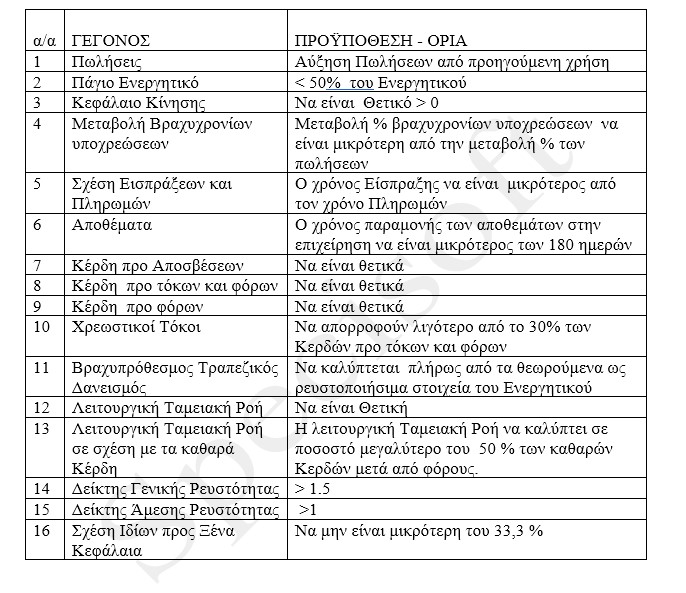
In detail:
1. Sales:
Condition: An increase over the previous year.
Increase % = (Sales for the Year – Sales of the Previous Year)/ Sales of the Previous Year * 100 %.
It is important that there is a positive change in sales compared with the previous year.
An increase in sales shows dynamism and that the business is establishing itself in the market.
It is one of the first things evaluated.
2. Fixed Assets
Condition: Fixed assets should be less than 50% of total assets.
Fixed Asset Percentage = Fixed Assets / Total Assets * 100 %.
This is a general rule; in specific cases a different proportion may apply.
It is important that the business has significant easily realisable assets, which is ensured by keeping total fixed assets below 50% of assets.
3. Working capital
Condition: It should be positive.
Working Capital = Current Assets – Short-term liabilities.
If it is positive then, as its definition shows, the easily realisable assets (current assets) cover the short-term liabilities, so the business is able to pay without problems.
There is of course the question of how far inventories are easily realisable and real, and for this reason net working capital excluding inventories is considered more valid (instead of current assets in the above formula, we take current assets less inventories).
4. Change in Short-term liabilities
Condition: The % change in short-term liabilities should be smaller than the % change in sales.
What this condition really shows is that any increase in sales must be accompanied by a suitable collection policy, so that the business can pay suppliers, short-term loans and other short-term liabilities with relative ease.
As a result, any increase in short-term liabilities (which will arise anyway because of the increase in sales) will not create proportionately greater liabilities and hence exposure to risk.
This is easier to understand today because of the crisis in the market where, apart from the fall in sales, there is great uncertainty about collections and an increase in business risk.
5. Relationship between Collections and Payments
Condition: The Collection period should be shorter than the Payment period
It is a self-evident condition, but one that is hard to apply.
The usual practice for a company is to pass on to the customer, and in fact slightly extended, whatever indirect financing it gets from each supplier through the few months’ credit it is given. This helps sales, but is not without risks.
So the condition should be met as far as possible, and in any case the effects should be calculated.
6. Inventories
Condition: The time inventories stay in the business should be less than 180 days.
This is a general rule, a general average.
A more valid figure is the one for the sector to which the business belongs.
The purpose of inventories is to allow sales to run smoothly.
But large inventories tie up capital. The business must therefore hold the minimum possible inventories that allow sales to continue smoothly.
We measure it in days that inventories stay in the business.
7.Profit before Depreciation
Condition: It should be positive.
If profit before tax is positive, the condition is certainly met.
The issue arises when profit before tax is negative.
Then it is important that profit before depreciation is positive, given that depreciation is an accounting expense arising from investments already made.
8.Profit before interest and tax
Condition: It should be positive.
If profit before tax is positive, the condition is certainly met.
The issue arises when profit before tax is negative.
Then, if the condition is met, that is, if profit before interest and tax is positive, this means the business becomes profitable immediately with a suitable capital increase.
9. Profit before tax
Condition: It should be positive.
It is the self-evident condition and the purpose of profit-making businesses.
The business is strong when it shows profits over the long term.
10. Interest Expense
Condition: It should absorb less than 30% of Profit before interest and tax.
This is a general rule. In general, the smaller the part of profits absorbed by interest expense, the better.
It is important that it is lower than the average of the sector to which the business belongs.
11.Short-term Bank Borrowing
Condition: It should be fully covered by the Assets considered immediately realisable.
It is important for banks to be convinced that the business can cover its obligations to them from secure, immediately realisable assets.
12. Operating Cash Flow
Condition: It should be Positive.
The cash flow arising from the operation of the business itself must be positive. This means the business has an activity that yields an operating profit, which is essential for any decision.
13.Operating Cash Flow in relation to net Profit
Condition: Operating Cash Flow should cover more than 50% of net Profit after tax
This is a general rule.
It is important to compare it with the average of the sector to which the business belongs.
14. Current Ratio
Condition: it should be > 1.5.
This is a general average, and it is important to compare it with the average of the sector to which the business belongs.
It is calculated by dividing average current assets (including prepayments and accrued income) by average short-term liabilities (including accruals and deferred income).
This Ratio measures the surplus of liquid funds over current liabilities. The surplus of current assets over current liabilities provides a margin of safety for those who have invested money in the business.
15. Quick Ratio
Condition: it should be > 1
This is a general average, and it is important to compare it with the average of the sector to which the business belongs.
It is calculated by dividing average current assets, after deducting inventories (including prepayments and accrued income), by average short-term liabilities (including accruals and deferred income).
This Ratio shows the ability of the business to service its short-term liabilities by liquidating its immediately realisable assets. Inventories are deducted because, on the one hand, they are the least liquid of the current assets and, on the other, liquidating inventories is very likely to result in a loss.
16. Equity to Debt Ratio
Condition: It should not be less than 33.3 %.
This is the well-known general rule that the ratio of equity to debt should be 1 : 2.
It shows how over-indebted the business is. It is used by the lenders of the business to assess the degree of security that equity gives them, and also by the management and shareholders of the business to see the level that the use of financial leverage has reached.
It must of course be compared with the average of the business’s sector.
The Company Specisoft S.A.
Specisoft S.A. was founded in 1987 as a specialised software development company, its main characteristic being the development of software on subjects involving knowledge, high specialisation, special optimisation algorithms and very large-scale data processing.
The subjects of the programs (among others) concern a) Business software (Business Planning – Business Plan, Financial Analyses of Balance Sheets, Business Valuation, Standard Costing, Forecasts, Investment Appraisals etc.), b) Financial software (Fundamental Analysis, Portfolio Selection etc.), c) Business Games (Business Simulators), d) Optimisation of Economic Problems, e) Educational software on the above subjects.
The programs run on WINDOWS locally, on a network and over the INTERNET.
Almost all the company’s employees are university graduates. In addition, the company employs specialised, highly experienced external associates holding postgraduate degrees (Master’s and PhD) and has university professors as advisers.
The company’s customers are Businesses, Business Consultants, Accounting firms, Public Organisations, Municipalities etc. Among its customers (the company has more than one thousand seven hundred) are many of the largest Greek companies, more than eighty-five of them listed on the Athens Stock Exchange.
A very important part of the company’s customer base is the Greek higher-education Institutions (universities and technological institutes), Vocational education (Public and Private vocational institutes), Colleges, Seminar Organisations, Vocational Training Centres etc., which equip their laboratories with the company’s programs, used directly in the training of their students. Specisoft, with its software technology, its specialised optimisation algorithms and the knowledge of specialist financial subjects that it embodies in the software it produces, can be described as a knowledge company within the emerging knowledge economy.
Specisoft S.A.
17 Pergialitou St., 15451 Neo Psychiko
Tel: +30 210-6911468, Fax: +30 210-6993791
e-mail: info@specisoft.gr, SITE: www.specisoft.gr