

By: Athanasios Takopoulos
Business Consultant, external associate of Specisoft S.A.
Contents
1. Bank Borrowing
1.1. Working capital loans
1.2. Long-term loans
1.3. Guarantee Fund TEMPME S.A. – ETEAN etc.
2. Venture Capital
3. Factoring
4. Private Investors (Business Angels)
5. Business Incubators
6. Leasing
7. Stock Market
1.Bank Borrowing
Bank Borrowing is today the most common way businesses turn to in order to find financing. Banks offer two broad categories of loans to businesses: loans for Working Capital and Long-term loans.
The Working Capital loans aim to improve the liquidity of the business and are by nature of short duration.
By contrast, the Long-term loans are of long duration and include establishment loans and loans for professional equipment.
The interest rate on Long-term loans is usually lower than the corresponding interest rate on loans Working Capital precisely because of the longer repayment period.
1.1. Working capital loans
Credit institutions today offer complete packages to cover the liquidity needs of small and medium-sized enterprises or of the self-employed.
Such products are open or revolving loans and overdraft accounts. With open loans, banks give their customer a credit limit up to which the customer can borrow.
The borrower may, if they wish, repay part or all of the debt, and may borrow again when in need up to the limit granted, without being required to return the capital used within a specific period.
There are banks that finance working capital up to as much as 100% of the business’s turnover and others where this percentage does not exceed 50% of turnover.
1.2. Long-term loans
Loans for business premises
Loans for business premises can finance up to 100% of the value of the property and their term ranges from 3 to 30 years depending on the bank and the customer, with interest rates that today (2004) range from about 5.50 to 9.50%. The final interest rate on these loans is increased by the Law 128/75 levy of 0.6%.
For new entrepreneurs banks usually provide a grace period of up to two years, during which new entrepreneurs are required to pay only the interest or smaller instalments. The loan expenses charged by banks usually do not exceed 1% of the loan.
Loans for the purchase of fixed equipment
Loans of this kind are granted for the purchase of fixed equipment (furniture, machinery etc.). The repayment period of these loans reaches 15 years, with an interest rate ranging from 6.25% to 10%. The financing can cover the whole investment in the purchase of fixed equipment, and disbursement can be made either in a lump sum or gradually as the purchases progress.
1.3. Guarantee Fund (TEMPME S.A.)
Philosophy
The basic operating principle of TEMPME S.A. is the sharing of risks between the private and the public sector (businesses, credit and financial institutions and TEMPME S.A.).
Based on this principle, the Philosophy of the company focuses on:
Encouraging all socio-economic groups to exercise their right to Entrepreneurship, limiting the social consequences in the event of a business failure.
For this reason the Regulation on the Provision of Guarantees and the Operation of TEMPME S.A. (Joint Ministerial Decision 12882/867, Government Gazette B 1065/31.7.2003) forbids the entrepreneur’s permanent and only home being burdened with a pre-notation or mortgage when TEMPME S.A. provides a guarantee in their favour (provided, of course, that the home is not already pre-notated or mortgaged)
Covering the gaps in the financial market and meeting the needs of Small and Micro Enterprises at low cost, with the aim of limiting usury and the shadow economy at the expense of Small and Micro Enterprises
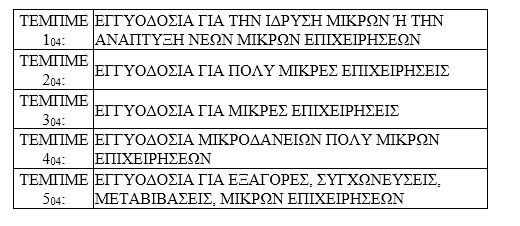
Today the Fund has created 5 different programmes / products concerning guarantees for medium- to long-term and short-term loans for new or existing businesses of any form (sole proprietorships, limited and general partnerships, limited liability companies, sociétés anonymes).
The amount of the loan the Fund can guarantee ranges, depending on the Programme, from €10,000 to €320,000, the coverage of the loan from 45% to 70%, and the annual commission is, on average, about 1% of the outstanding balance of the loan.
Guaranteed medium- to long-term loans of TEMPME S.A. with a term of 3 years or more for Programmes 1, 2 and 3, and of 1.5 years or more for Programme 4, are covered by a counter-guarantee of the European Investment Fund, under the Multiannual Programme of the European Union for Enterprise and Entrepreneurship, and more specifically for Small and Medium-sized Enterprises.
2. Venture Capital
An alternative way of financing that has recently started in Greece too is through what is widely known by its international name, Venture Capital.
Today about 20 companies are active in Venture Capital in Greece. Venture Capital is as a rule a form of financing aimed at new, ambitious and fast-growing companies that usually exploit innovative ideas commercially.
How Venture Capital works
Venture Capital companies finance the businesses that are their clients in exchange for a percentage of their shares. This percentage varies according to the amount of financing and the size of the financed business, but as a rule is around 30%. The duration of the investment usually ranges between 3 and 7 years.
The businesses financed are usually dynamic, with innovative business ideas and business plans that promise high returns, capable of rewarding the Venture Capital companies for the risk they take.
The cooperation of Venture Capital companies is not limited to providing capital ; help is also provided with the management, marketing, staffing and strategic planning of the business. Also important for the financed business are the relationships of the Venture Capital company with other businesses in the market, which may be useful in forming partnerships.
The great advantage of financing through Venture Capital is that the business is not obliged to provide guarantees for the capital provided to it. So even if the business fails, the Venture Capital company does not claim back the money it invested in the business, provided of course that the terms of the agreement between the two sides were observed.
3. Factoring
Factoring of business receivables is carried out by banks and by companies whose exclusive purpose is this activity.
Factoring involves a contract between the supplier and the factor (a bank or factoring company) under which the supplier assigns to the factor its receivables from its customers – debtors.
The factor undertakes the management, collection, discounting, credit control and coverage of the credit risk of the supplier’s receivables.
The financing institution usually pays the business about 80% of the amounts owed immediately. It also charges the company 0.5 to 2% of the amount of the customer receivables for managing the portfolio.
Factoring is an effective way of financing working capital and an easy and quick way of improving the liquidity of a business, while at the same time the operating cost is reduced and the productive capacity of businesses is increased, as the processes of managing, accounting for and collecting the receivables of a business are assigned to the credit institution acting as factor.
Businesses turn to this way of financing in the following cases:
- To be financed immediately for their current needs when they have no collateral
- When they have increased demand for products or services and can respond only on unfavourable terms towards their suppliers
- When the processes of collecting their receivables are extremely costly
- When they have large losses from insolvent customers.
- Private Investors (Business Angels)
This term refers to private investors who have capital and professional experience in a specific field, which they make available to new entrepreneurs in the form of a long-term investment.
In Greece financing of this kind is neither institutionalised nor particularly widespread, as it is internationally, and is usually limited to financing from relatives. In the coming years, however, financing from private investors is expected to spread in Greece too.
5. Business Incubators & Technology Parks
Worldwide, the term Business Incubator (or simply Incubator) refers to a company that provides newly founded companies with prospects of rapid growth with financing (to a lesser extent than that offered by VCs), premises and equipment (such as buildings, furniture, computers, telephones, internet access etc.), secretarial support services, advisory services and support (for example on tax, accounting, legal, IT and recruitment matters etc.), as well as a network of contacts with customers and suppliers, and in return takes a percentage of the share capital and / or payments from the newly founded company.
In general, the mission of the Incubator is to found and grow the new company so that it successfully reaches the door of the VC and can then ask, with proper infrastructure and professional preparation, for the first sizeable investment that will allow it to grow and establish itself in the market.
The duration of the investment of the Incubator usually ranges between 6 and 18 months. In Greece, through the state – European funding of the “Eleftho” programme, the first Greek “incubators” in the international sense of the term have been founded and are now operating normally.
These incubators are, for the time being:
- .i-Cube S.A. Athens http://www.i-cube.gr/
- Innovative Ventures SA i-Ven Athenshttp://www.iven.gr/
- Thermi S.A. Thessaloniki http://www.thermokoitida.gr/
- Thessaloniki Incubator Thessaloniki http://www.thestep.gr/
- Xtend B2B Athenshttp://www.xtendb2b.com/
- Chania New Business Incubator Chania http://www.incubator-chania.gr/
- Heraklion Technology Park Heraklion http://www.stepc.gr/
while two more incubators are expected to start operating.
These incubators have been created by (and belong entirely to) Greek VC companies, companies of general investment services and business consultants, or private investors. It should be stressed that, although they generally follow the operating model of international incubators as described above, their approach to it is different.
The differences lie mainly in the way and the amount of financing they offer new entrepreneurs. Thus, some Greek incubators have their own funds with which they finance the incubatees (the new companies they take under their protection), while others simply mediate and put the new companies in touch with VC companies that undertake their financing.
The duration of the investment of the Incubator usually ranges between 6 and 18 months.
The criteria for evaluating new businesses that are candidate Incubatees are common to most incubators and include:
1 The qualifications of the management team (such as relevant experience, determination and dedication, quality and leadership qualities as elements of character etc.).
2 The business model and product / service (such as patents, the market’s need for the specific product / service, the viability of the business model, working capital and investment needs, the potential to expand into other markets, the level of existing competition, the barriers to entry of new competitors, possible partnerships, the cost and viability of the proposed marketing activities, possible synergies with other companies in the incubator, the proposed timetable for implementing the business plan, the business risks etc.).
3 Other investment – financial criteria (such as financing needs against the equity stake offered, the stage of the investment, the structure of the shareholders’ agreement, compatibility with existing incubatees, the availability of the members of the management team to support the company etc.).
Some other efforts being made in our country, by either the private or the public sector, probably fall short of the full concept of the Incubator, mainly because they do not include the financing part and the consequent holding of part of the capital of the new business.
The most widespread form in our country is the “technology parks” created by bodies (municipalities, professional and/or scientific associations etc.) in order to promote specific interests through the creation of new businesses (e.g. development of specific technologies, reduction of unemployment in a specific area etc.), which are limited to providing new businesses (mainly) with premises and (optionally) support services for a fee.
Such (indicatively) are the “incubators” of Lavrio, Chania and Larissa and the Thessaloniki technopolis (which is planned to include an incubator in the full sense of the term too); the creation of the Acropolis high-technology park in Athens has been announced; and in the same category we can probably also place the private multinational company Regus (which simply provides premises and secretarial support services).
- Leasing
Leasing is an integrated financing mechanism that enables a business to create or expand its production equipment without using its own funds.
The funds required are provided by the Leasing company, which buys the equipment according to the instructions of the business. It then leases this equipment to the business for a predetermined period and for a specific rent.
At the end of the contract the business can buy the equipment by paying a small amount which may not exceed 5% of the value of the equipment. Alternatively it can return the equipment to the Leasing company or continue the lease.
Lease instalments are paid monthly, quarterly or half-yearly. The interest rate used to calculate the instalments is slightly higher than the corresponding borrowing rate. The business will also be required to pay a one-off amount of 0.1% to 1% of the value of the investment for management costs. The repayment period is 3 to 5 years, and financing can reach up to 100% of the value of the equipment.
Leasing as a form of financing has many advantages, especially for new businesses.
Specifically, the business:
- Does not need to pay immediately the amounts required to buy the necessary equipment, which is essential for new and small businesses with little liquidity
- Is not forced to resort to excessive borrowing
- Has the option at the end of the lease to buy the equipment, or to terminate or renew the contract.
- Is exempt from tax on the equipment it leases, since all the instalments are recognised as an operating expense
- Shows a better picture in its financial statements, as certain financial ratios are not adversely affected
- Does not need to provide large guarantees, as with bank borrowing, because Leasing procedures are simpler and faster.
7.Stock Market
The Stock Market is an alternative source from which businesses can raise capital.
For Small and Medium-sized Enterprises, the New Stock Market (NEXA) was created some years ago. That market was later abolished.
A new market has now been announced, with many innovations regarding the companies that can be listed and its operating conditions in general.
It will operate soon, probably within 2007, and will provide a solution for many small and medium-sized enterprises
The Company Specisoft S.A.
Specisoft S.A. was founded in 1987 as a specialised software development company, its main characteristic being the development of software on subjects involving knowledge, high specialisation, special optimisation algorithms and very large-scale data processing.
The subjects of the programs (among others) concern a) Business software (Business Planning – Business Plan, Financial Analyses of Balance Sheets, Business Valuation, Standard Costing, Forecasts, Investment Appraisals etc.), b) Financial software (Fundamental Analysis, Portfolio Selection etc.), c) Business Games (Business Simulators), d) Optimisation of Economic Problems, e) Educational software on the above subjects.
The programs run on WINDOWS locally, on a network and over the INTERNET.
Almost all the company’s employees are university graduates. In addition, the company employs specialised, highly experienced external associates holding postgraduate degrees (Master’s and PhD) and has university professors as advisers.
The company’s customers are Businesses, Business Consultants, Accounting firms, Public Organisations, Municipalities etc. Among its customers (the company has more than one thousand seven hundred) are many of the largest Greek companies, more than eighty-five of them listed on the Athens Stock Exchange.
A very important part of the company’s customer base is the Greek higher-education Institutions (universities and technological institutes), Vocational education (Public and Private vocational institutes), Colleges, Seminar Organisations, Vocational Training Centres etc., which equip their laboratories with the company’s programs, used directly in the training of their students.
Specisoft, with its software technology, its specialised optimisation algorithms and the knowledge of specialist financial subjects that it embodies in the software it produces, can be described as a knowledge company within the emerging knowledge economy.
Specisoft S.A.
17 Pergialitou St., 15451 Neo Psychiko
Tel: +30 210-6911468, Fax: +30 210-6993791
e-mail: info@specisoft.gr, SITE: www.specisoft.gr