

“There is no favourable wind if you do not know where you are going”
Which, read another way, means: “If you know where you want to go, the right conditions needed to reach your goal – destination will be found too”
This is particularly useful in life in general and especially in businesses, which this article is about.
In other words, every business, small or large, must study the data of its economic and social environment, imagine developments, produce ideas for new markets and products, set a strategy and, of course, be able to turn qualitative elements into measurable financial figures.
It must process these data with suitable methods in order to take decisions on every matter that concerns it, so as to achieve its goals.
The science of business administration recommends business planning (the Business Plan) as one of the essential elements a modern business must have, for both short-term and long-term planning.
This article describes the basic elements that make up a business plan and places particular emphasis on processing the quantitative data, in order to help the management of the business take decisions
A. The main elements that should be included in a Business Planning study
- Summary with the essential elements of the business plan
- The purpose and vision of the business
- Current state of the business
- The company (Ownership, Management etc.)
- The sector in which it operates
- The market (customers, market size etc.)
- The Competition
- The existing products
- Production data (if it is a manufacturing business)
- Production facilities
- Production processes
- Production Materials
- Quality control
- Other production data, as the case may be
- Pricing Policy
- The Distribution Network
- Marketing & Sales
- Advertising
- Public Relations
- Sales (sales promotion, sales department)
- Financial Data
- Strengths – Weaknesses – Opportunities – Threats (SWOT)
- New Situation – Business Plan
- Long-term and Short-term goals
- Strategy for achieving the goals
- Intensive growth matrix
- Investment plan
- Financing
- Financial Data
- Budgets
- Cash Flow
- Results
- Balance Sheets
- Financial Analysis of results
- Development of financial figures
- Sources and Uses of funds
- Break-Even Point
- Sensitivity Analyses
- Profit under price changes
- Profit under changes in expenses
- Profit under changes in sales
- What If Analysis
- Scenarios
- Risk Analysis
- Decisions
- Implementation Timetable
In any case, emphasis and of course more analysis should be given to those elements that give the clearest information to those for whom the business plan is mainly written, e.g. for finding financing from interested investors, etc.
Essential elements of a business plan are commented on below
B. Essential elements of a business plan
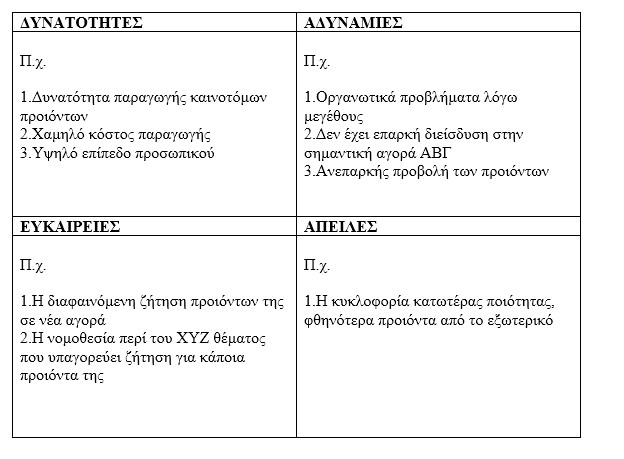
1. Strengths – Weaknesses – Opportunities – Threats (SWOT)
It is extremely important to draw up a table with these four critical elements.
These elements will help derive the guiding strategies of the business.
It will dictate things such as: Decisions on promotion, producing new products, investments, entering new markets etc.
2. Matrix – Intensive growth strategies
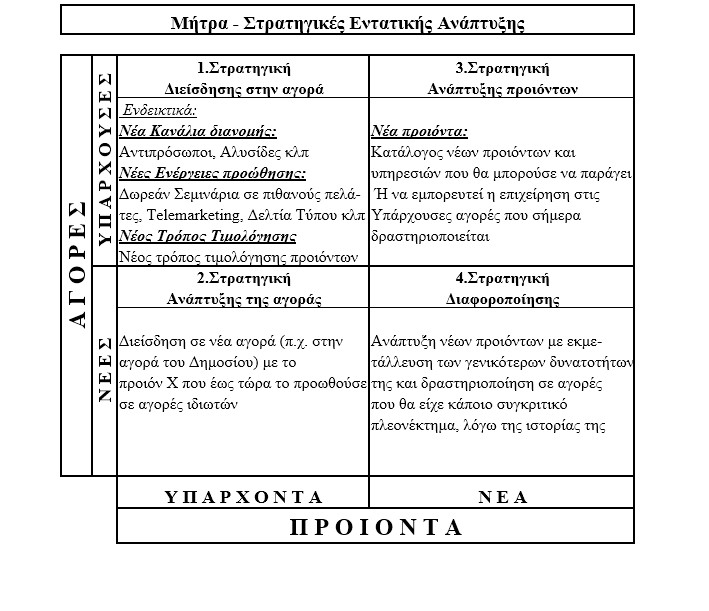
It is very important to draw up the matrix below, which shows possible strategies for the intensive growth of the business.
The vertical axis shows the existing and potential new markets in which the business could operate.
The horizontal axis shows the existing products and the new products the business could potentially produce
It goes without saying that the products may be of its own production, or it may trade third-party products, or they may be services.
In detail:
Existing Products in Existing Markets
Market penetration strategy: An effort to increase sales through more rational marketing-mix actions.
Existing Products in New Markets
Market development strategy: An effort to increase sales by promoting the products in markets where they could be sold and in which the business has not been active until now.
New Products in Existing Markets
Product development strategy: An effort to increase sales by producing or trading new products and services that could be sold in the existing markets in which the business now operates
New Products in New Markets
Diversification strategy: An effort to increase sales with new products in new markets, making use of the wider capabilities and opportunities of the business
3. Cash Flows – Cash Flow
A most basic element of the business plan is the forecast of future cash flows, which will show whether the business plan is financially feasible.
Also the financing needed from share capital.
Indicative Cash Flow Chart – Cash Flow
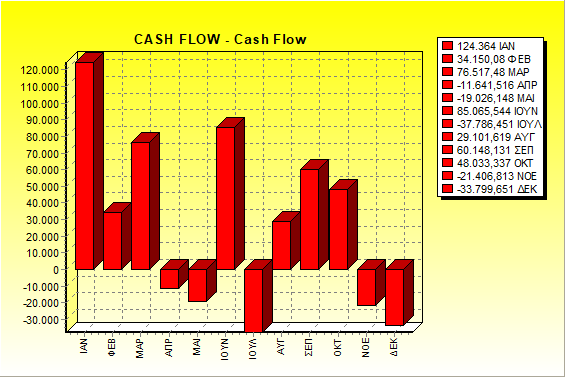
Using the Cash Flow, we also create the business’s cash programme statement, which shows, among other things, the working capital needs
We must combine the cash programme statement with the statement of sources and uses of funds, to see how the business is financed and thus avoid, for example, financing fixed assets with working capital loans
If this is finally necessary, it can be done with long-term loans or share capital
4. Break-Even Point
The break-even point of the business’s operation is one of the most basic figures to be calculated.
It shows, both as an amount and as a percentage of forecast sales, the point at which the business covers its expenses, both fixed and variable, and beyond which it begins to make a profit.
Indicative Break-Even Chart
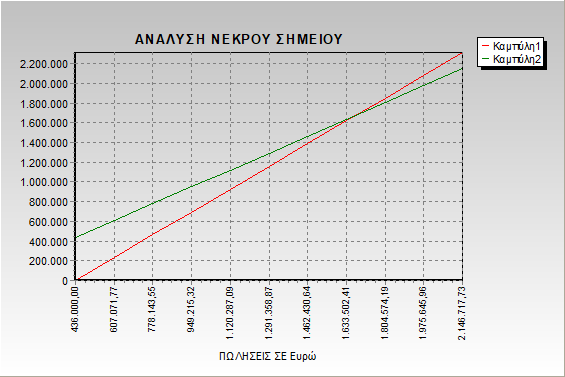
It is clear that the lower the Break-Even Point, the more stable the business, given that all forecast figures are estimates and so may not materialise as forecast
In the chart, the green curve represents expenses and the red one is the diagonal used to show where Sales (horizontal axis) equal expenses (vertical axis, where fixed expenses can be seen to be about 420,000 Euros).
The break-even point is about 1,650,000 Euros, which means that with sales of 1,650,000 Euros we cover both the fixed cost of the business (salaries, rents etc.) and the variable cost (cost of purchasing materials or products, commissions etc.)
A profit will be made if we finally have sales above the level of 1,650,000 Euros, which is very important for the management of the business to know
5. Sensitivity Analyses
It is clear that, with all the estimates made in creating the business plan, the question of the reliability of the results arises.
Sensitivity analysis at many levels is therefore necessary. The subject is vast. Here, only certain data are simply presented in chart form.
The charts below show:
- Profit under price changes (from -10% to +10%)
- The profit function (profit as a function of sales)
- The target-profit curve (sales required to achieve a given desired profit)
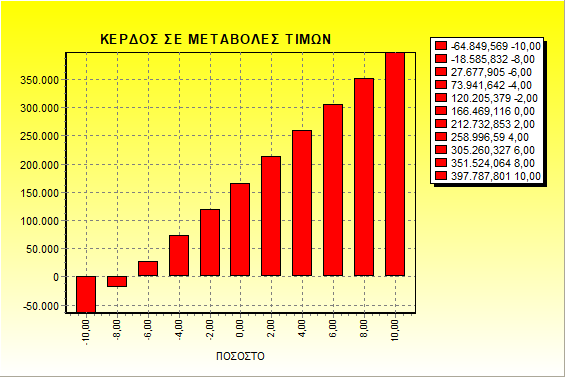
Chart of profit as a function of changes in selling prices
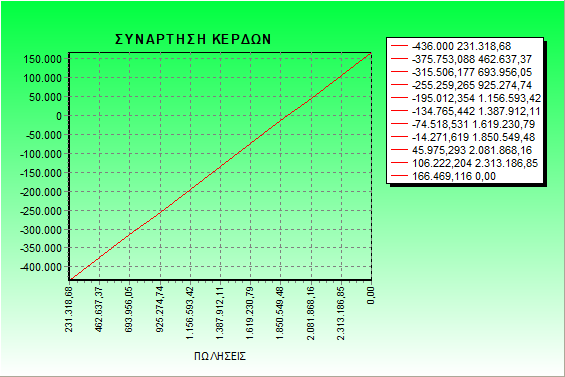
Chart of the profit function (profit as a function of sales)
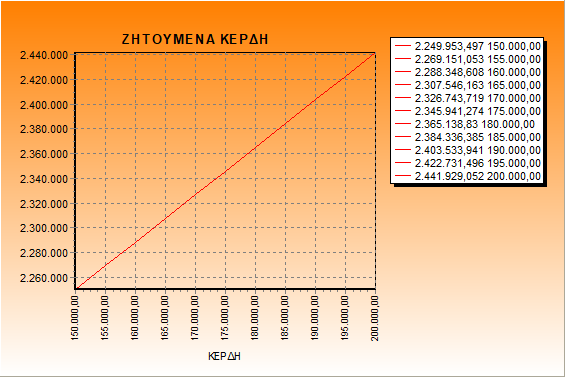
Chart of required sales as a function of desired / target profit
- Risk Analysis
Risk analysis is another vast subject that cannot be analysed here in its full extent
The risks to the business from all possible factors (social and economic environment, legislation etc.) should be assessed and quantified as far as possible.
Management’s decisions should take these factors and their possible effects seriously into account
Below, two charts present the effect of quantified risk factors on the business’s profit.
Probability distributions were ‘tied’ to the basic elements that shape the business’s profit (probability distributions for sales, profit margin and expenses), followed by a Monte Carlo simulation; the results are shown in the charts below
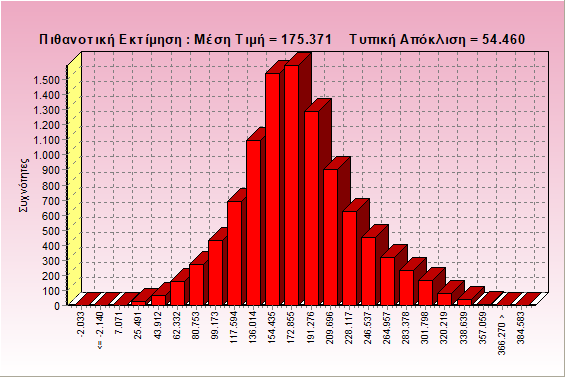 Chart of the probability distribution of profit
The chart shows that the mean profit will be 175,371 Euros and the standard deviation 54,460 Euros.
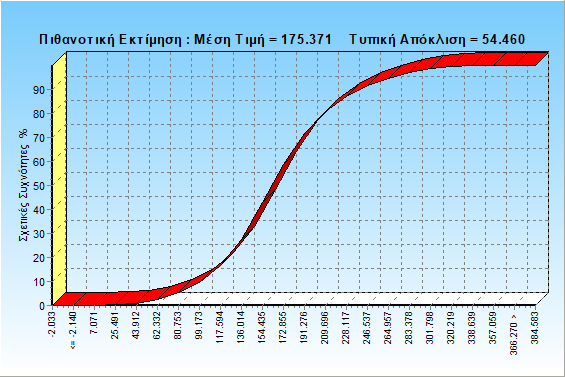 Chart of the cumulative distribution of profit
The above chart is most useful, because it gives answers to questions such as:
With what probability will the business have a profit above, say, 200,000 Euros
Or
With 99% probability, what is the minimum profit the business will make
The Company Specisoft S.A.
Specisoft S.A. was founded in 1987 as a specialised software development company, its main characteristic being the development of software on subjects involving knowledge, high specialisation, special optimisation algorithms and very large-scale data processing. The subjects of the programs (among others) concern a) Business software (Business Planning – Business Plan, Financial Analyses of Balance Sheets, Business Valuation, Standard Costing, Forecasts, Investment Appraisals etc.), b) Financial software (Fundamental Analysis, Portfolio Selection etc.), c) Business Games (Business Simulators), d) Optimisation of Economic Problems, e) Educational software on the above subjects.
The programs run on WINDOWS locally, on a network and over the INTERNET.
Almost all the company’s employees are university graduates. In addition, the company employs specialised, highly experienced external associates holding postgraduate degrees (Master’s and PhD) and has university professors as advisers.
The company’s customers are Businesses, Business Consultants, Accounting firms, Public Organisations, Municipalities etc. Among its customers (the company has more than one thousand seven hundred) are many of the largest Greek companies, more than eighty-five of them listed on the Athens Stock Exchange.
A very important part of the company’s customer base is the Greek higher-education Institutions (universities and technological institutes), Vocational education (Public and Private vocational institutes), Colleges, Seminar Organisations, Vocational Training Centres etc., which equip their laboratories with the company’s programs, used directly in the training of their students.
Specisoft, with its software technology, its specialised optimisation algorithms and the knowledge of specialist financial subjects that it embodies in the software it produces, can be described as a knowledge company within the emerging knowledge economy.
Specisoft S.A.
17 Pergialitou St., 15451 Neo Psychiko
Tel: +30 210-6911468, Fax: +30 210-6993791
e-mail: info@specisoft.gr, SITE: www.specisoft.gr