

A. The Business (in general)
B. Financial Management Tools
- Preparing and monitoring a Cash Flow statement
- Long-term Calculation of the Working Capital Needed
- Expenses, Depreciation of fixed assets
- Fixed and Variable expenses
- The Break-Even Point of the business’s operation and its Calculation
- Loans. Types of loans and Calculation
- Sources and uses of funds
- Cash flows
- Financial Ratios
- Product costing
- Investment appraisal & calculation of return (IRR, NPV)
- Added value
The Business (in general)
The Business, before the law, is a legal person, by analogy with the concept of the natural person.
It is born legally by a contract, is entered in books kept by the state, lives, acquires property, is governed by laws etc. and dies on a predetermined date, or if its founders so wish, or if it cannot meet its obligations.
From its establishment it also acquires its first money, that is, its initial capital, which however it owes at its end to those who provided it, that is, to its shareholders. To its shareholders it also owes the profits it makes each year, as well as whatever money from its profits it does not distribute, which is called reserves.
During its operation, it happens to borrow money from banks and others. It owes this money to those from whom it borrowed, within a predetermined period. If this period is long, lasting some years, it is called long-term borrowing; if it owes the money within a short period, it is called short-term borrowing.
It also owes money to those who grant it certain facilities, that is, to those it should have paid because it bought something and, although it should have paid them, it owes them. It is as if they lend it an amount equal to the value of the purchase, the business pays them off at the time of purchase and owes them the ‘loan’ they gave it. These are called suppliers.
Through this mechanism we see that the business collects money from its shareholders, from banks, from its suppliers and from others who for some reason give it money.
All this money that the business owes is called Liabilities.
The business places the money it has collected somewhere. It places it in cash, in things it bought to fulfil the purpose for which it was set up, called fixed assets, in merchandise it buys, in bonds, in investments in other businesses, in credit facilities to its customers from the sales it makes, by analogy with the mechanism of its suppliers towards it; in general, the money it collects it places ‘somewhere’, and that ‘somewhere’ owes it to the business.
All this money that the business has placed somewhere, and that is owed to it, is called Assets.
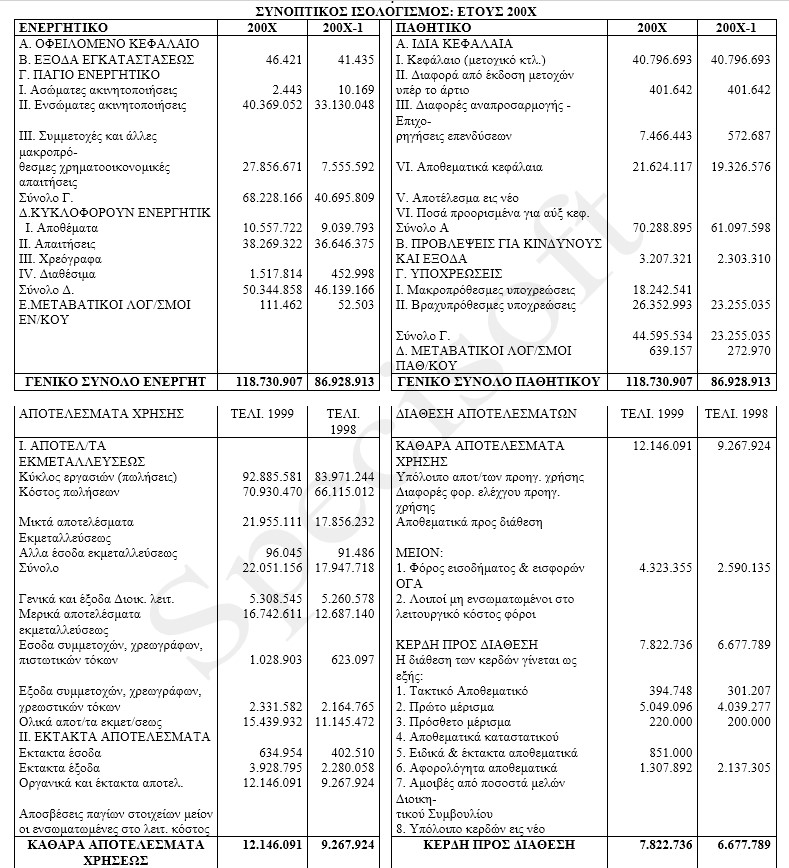
All this is shown in certain financial statements.
The main one of these is called the balance sheet and has the form of two columns. One column shows the assets (where the business has placed its money, where it has invested it), and the other the liabilities (where the business got its money from).
So the balance sheet is a financial statement that presents the financial position of the business, since it presents what the business owns and what it owes.
More precisely, the balance sheet is a financial statement that depicts the asset structure of the business.
The liabilities side shows the sources of the business’s funds and the assets side shows their uses, that is, the investments of the business.
Another financial statement is the Income Statement, which shows the financial result (profit or loss) the business had from its operation in the past year, that is, in the financial year.
A third important financial statement is the General Operating Account, which shows, in a different presentation, how the financial result (profit or loss) of the year was achieved.
Asset Accounts
Capital due
Formation expenses
Fixed Assets
- Intangible assets
- Tangible assets
- Investments and other long-term receivables
Depreciation
Current assets
- Inventories
- Receivables
- Securities
- Cash and cash equivalents
Prepayments and accrued income
Liability Accounts
Equity
- Capital (share capital etc.)
- Share premium
- Revaluation differences – Investment grants
- Reserves
- Result carried forward
- Amounts intended for capital increase
Provisions
Liabilities
- Long-term (Long-term Loans)
- Short-term
- Banks (working capital)
- Suppliers
- Others
Accruals and deferred income
Income Statement Accounts
NET RESULTS FOR THE YEAR =
Turnover (sales)
– Cost of sales (= Gross Operating results)
+ Other operating income (= Total operating income)
– General and Administrative expenses
– General and Distribution expenses (= Partial operating results)
+ Income from investments, securities, interest received
– Expenses of investments, securities, interest paid (= Total operating results)
+ Extraordinary income
– Extraordinary expenses (= Ordinary and extraordinary results)
– Depreciation of fixed assets less that included in operating cost
Appropriation of the results for the year
PROFIT FOR APPROPRIATION =
Net results for the year
+ Balance of results of the previous Year
+/- Tax audit differences of the previous Year
+ Reserves for distribution
– Income tax & OGA contributions
– Other taxes not included in operating cost
Profits are appropriated as follows
- Reserves
- Dividends to shareholders
- Directors’ fees
- Balance of profits carried forward
B. Financial Management Tools
The whole operation of the business’s finances is planned and monitored by the Finance Department, which may also use Business Consultants for support.
The business will have to make Investments, from which it should expect to make a profit. This raises the question of appraising the Investment it intends to make.
The business must look at its future in an organised way. It must therefore prepare annual and multi-year business plans (Business Plans).
The business must be able to determine, in a convenient and efficient way, the cost of its products , whether it produces and trades them or simply trades them.
The business must be able to determine its value at any time.
The business lives in a constantly and dynamically changing environment. To be able to plan, choose and take decisions, it needs various aids, statements and tools, which are indispensable.
Various tools, statements and aids are described below:
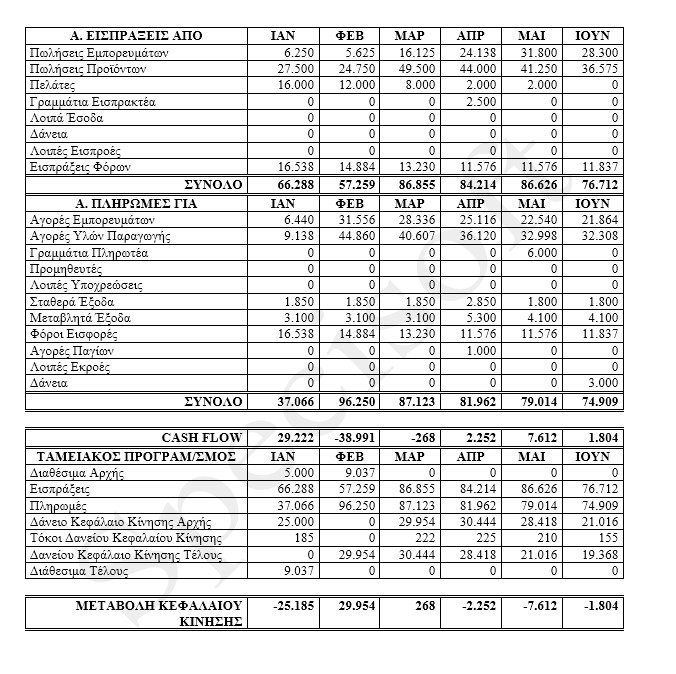
- Preparing and monitoring a statement of Cash Flow
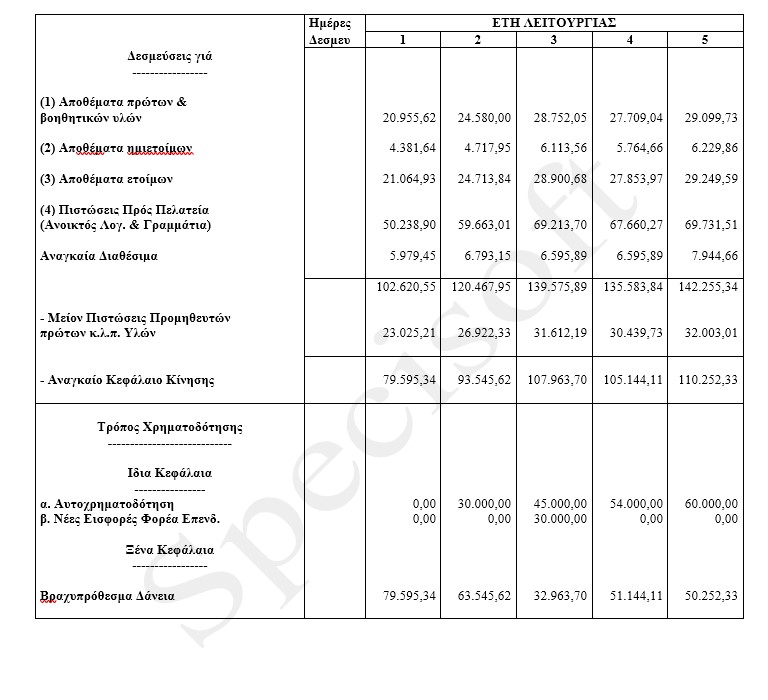
- Long-term Calculation of the Working Capital Needed
- Expenses, Depreciation of fixed assets
- Fixed and Variable expenses
- The Break-Even Point of the business’s operation and its Calculation
- Loans. Types of loans and Calculation
- Sources and uses of funds
- Cash flows
- Financial Ratios
- Product costing
- Investment appraisal & calculation of return (IRR, NPV)
- Added value
1. Preparing and monitoring a statement of Cash Flow
2. LONG-TERM CALCULATION OF THE WORKING CAPITAL NEEDED AND ITS FINANCING
 3. Expenses, Depreciation of Fixed Assets
An expense is the consumption of money to obtain a benefit which will be delivered within the financial year in which it is incurred. It is charged in full to the results of the year in which it is incurred (e.g. rent).
A purchase of fixed assets, or investment, is the consumption of money to obtain a benefit which will be delivered over many financial years and not only in the year in which it is incurred (e.g. a machine).
From this fact arises the need for part of the amount paid for the purchase to be treated as an expense in each year and charged to the results of that year (until, of course, the purchase amount is fully covered).
If we assume that the fixed asset has an estimated accounting life of 5 years, we must divide the amount by five and transfer 1/5 of it, i.e. 20%, to expenses each year. This 20% is called the depreciation rate.
In other words, we do not initially treat the amount we paid for the purchase as an expense. We treat it as an investment. The expense is created in the accounts. We thus draw up a table with amounts equal to 20% of the purchase amount, in our example, which will be treated as an expense each year and charged to the results. This amount is called depreciation and we track it separately.
The sum of the depreciation of all the years of the asset’s accounting life gives the purchase amount of the asset. The initial amount is thus covered, and we can regard it as an expense spread over the years following its purchase.
Example:
Suppose the purchase amount, that is, the acquisition cost of the fixed asset, was 1000 euros, and the depreciation rate 20%
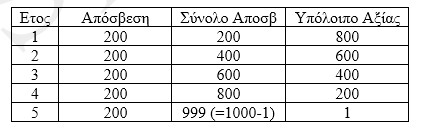
One unit is left (by law) to show us that the fixed asset exists.
Each year, in our example, the depreciation, that is, the accounting expense charged to the results, is 200 euros.
4. Fixed and Variable expenses
One of the most basic matters in businesses is the separation of expenses into fixed and variable.
Businesses are more stable when they have few fixed expenses.
Fixedexpenses are those that run in any case, regardless of whether the business is operating or not.
One way to picture this is to imagine the business closed for some reason, e.g. a holiday.
Let us consider which expenses keep running
What runs, then: Rents, Salaries etc.
Variable expenses are those that run as long as the business is operating (of course the fixed ones, which we have separated out, run too).
One way to picture this is to imagine the business in operation, e.g. on any given day.
What runs, then: Electricity, Consumables, Telephones etc.
What runs, then (on top of the fixed expenses), are the expenses created by the fact that the business operates and sells
If we assume, without loss of generality, that we have one product and express the variable cost per unit of product, we have:
Variable cost = X units of product * cost of product per unit
Where the unit cost includes both the acquisition cost (production or purchase) and the share of variable expenses attributable to the unit of product.
Based on the above, the cost of the business can be expressed as follows:
Cost = F + V = F + X * UC
Profit is: Sales – Cost = X*P – F – X * UC = X * (P-UC) – F
Profit is therefore greater (apart from the selling price P and the quantity sold X) when the business has: Low Fixed expenses F, and a Low cost per unit UC (of purchase or production and the related variable expenses)
5. The Break-Even Point of the business’s operation and its Calculation
As mentioned, the business lives in a dynamically changing environment. Whatever we budget for it has some probability of happening.
Within this uncertainty, it makes sense to calculate certain indicators with reverse logic.
One of them is the Break-even point of the business’s operation.
The break-even point of operation of the business is the level of sales at which, if we achieve it, we will neither gain nor lose. That is, the level of sales that covers both fixed and variable expenses.
‘Neither up nor down’, as the popular saying goes.
It is also expressed as a % of budgeted sales.
The lower it is, the better for the business; the more stable it is.
Break-Even Point = Fixed expenses / (Sales – Variable expenses)
We also calculate the indicators:
- Sensitivity analysis with respect to sales
- Sensitivity analysis with respect to variable expenses
Sensitivity analysis with respect to sales
It shows how much sales can fall in value (e.g. from a drop in prices), with everything else held constant, before the profit is used up, i.e. before we reach a break-even point of 100%.
ξ =[ 1-(Fixed expenses + Variable expenses) / Sales ] * 100%
Sensitivity analysis with respect to variable expenses
It shows how much variable expenses can rise (e.g. from a price increase by the supplier that is not passed on to selling prices), with everything else held constant, before the profit is used up, i.e. before we reach a break-even point of 100%.
ξ = [ (Sales – Fixed expenses) / Variable expenses – 1 ] * 100 %
It goes without saying that the break-even point can also be expressed for each product separately, and not only for the business as a whole, provided we have the allocations of expenses, as we have them in product costing
6. Loans. Types of loans and Calculation
Loans are, in general, of two kinds:
- Working capital loans
- Fixed capital loans
Working capital loans: These are loans needed because the business, in the course of its operation, needs money to pay its immediate obligations (e.g. rents, salaries, suppliers etc.) before it has collected the income from the sales of its products.
This need obliges it to resort to short-term borrowing, that is, working capital borrowing.
Its calculation is very simple. The bank charges the interest due for the days of borrowing, from the formula:
Interest = (r/100) * (days / 365) * Loan amount
Depending on the agreement between the business and the bank, the loan amount must also be repaid at some point.
Fixed capital loans: These are loans the business takes out in order to invest. In every investment effort, the business finances the investment with equity, long-term Borrowing, Leasing and perhaps a grant under development laws, a bond loan and other methods of long-term borrowing.
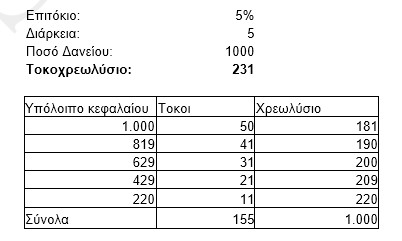
Calculating a fixed capital loan consists of first calculating the instalment (principal and interest) and then drawing up its detailed repayment table.
Example:
7. Sources and uses of funds
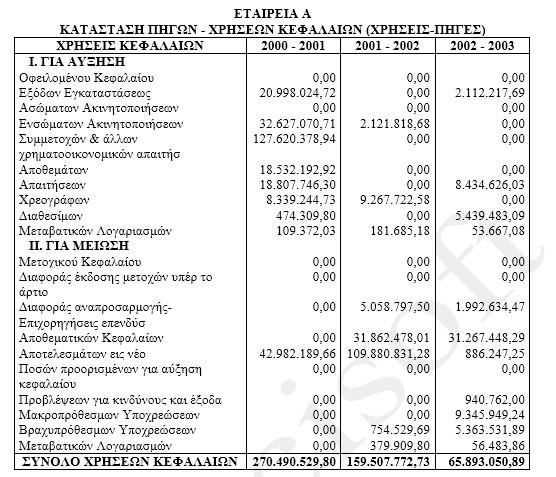
The statement of sources and uses of funds is one of the most important financial statements, because it shows us how the business is financed.
It is easily drawn up, bearing in mind the definition of the liabilities and the assets of the business:
Liabilities: They show the sources of funds, that is, how the business is financed. So every increase in liability items and, equivalently, every decrease in asset items is a source of funds
Assets: They show the uses of funds, that is, where the money that came from the sources of funds was invested. So every increase in asset items and, equivalently, every decrease in liability items is a use of funds.
To complete the statement we draw up a table showing the balance sheet figures of the current and the previous year. We calculate the differences in the accounts between the two years, and:
- If we have a positive change in asset items or a negative change in liability items, we put it under uses
- If we have a positive change in liability items or a negative change in asset items, we put it under sources
As is clear, sources and uses must be equal.
A typical statement of sources and uses of funds is shown on the next page
8. Cash flows
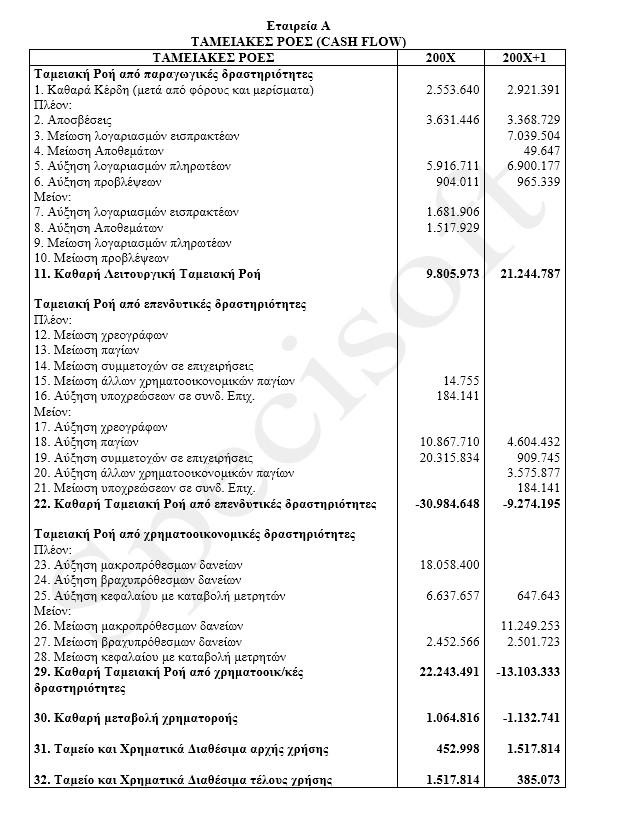
The cash flow statement, similar to the statement of sources and uses of funds, shows us with a different logic, based on the business’s cash, how the money that financed the business arose and where it went.
Starting, then, with the cash of the previous year and adding and subtracting the various items, we arrive at the cash of the current year.
It is considered a more detailed, clear and reliable way of showing how the business is financed.
The individual calculations are:
- Cash Flow from operating activities
- Cash Flow from investing activities
- Cash Flow from financing activities
The international standard is shown on the next page.
9. Financial Ratios
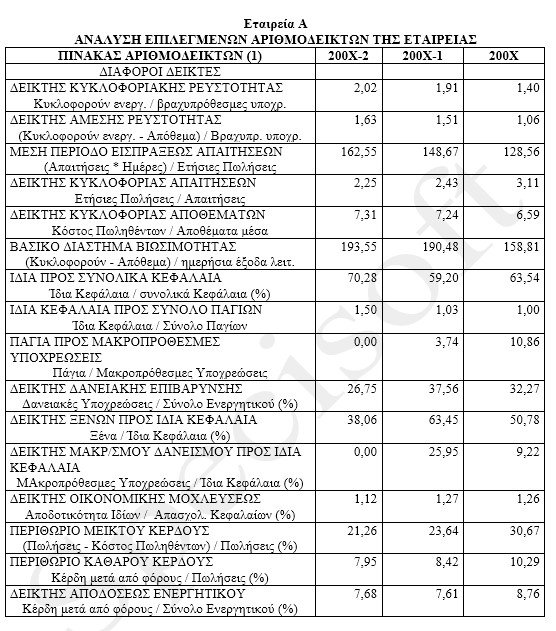
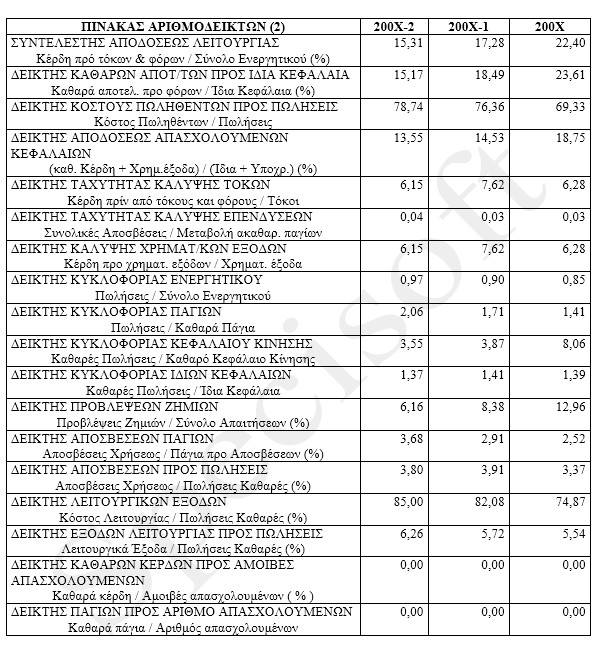
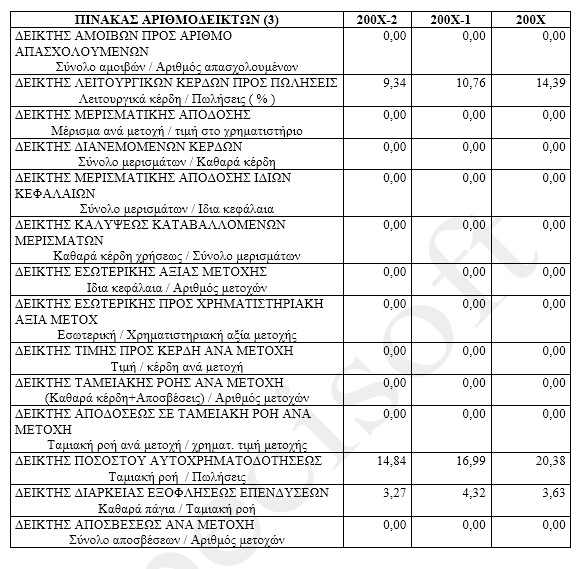
Financial ratios are ratios of various balance sheet figures, intended to show us the financial health of the business.
Since there is no single way to judge whether a business is in good financial condition, healthy etc. by calculating just one financial figure, each interested party, whether a shareholder, a bank or any other interested third party, turns to financial ratios to reach a conclusion on the question they want answered.
E.g.
- A bank would be interested in whether it is safe to lend to the business, and of course all it would care about is whether the business can repay the loan and the interest due. So it would be interested, among many other things, in e.g. the ratio of equity to debt, the debt burden of the business and much more.
- An investor would be interested, among many other things, in the return on equity
- On the other hand, a poor Cash Flow may mean explosive growth of the business.
Since, then, it is not easy to evaluate the business with a single figure, even one that is hard to calculate, we calculate several ratios and each interested party uses those that best show what they want.
The pages that follow show the main financial ratios and how they are calculated.
10. Product costing
Determining the cost of products is very basic, given that cost is the main means of exercising effective management.
We are talking about costing outside the accounts, not costing within the accounts, which determines cost after it has been incurred and is intended for the tax authorities, and so has distortions arising from that fact.
Industrial businesses seek to determine the cost of their products, even approximately
Commercial businesses usually do not even realise that they need it. And they do not do it, although they should. Perhaps they do not do it because they think the cost of the products they trade is the cost of buying them.
Service businesses are a more complicated case. In any event, the principles to rely on are the same.
There are various methods of calculating cost. The best known are Standard Cost and Activity Based Costing (ABC).
Below we will talk about Standard Cost.
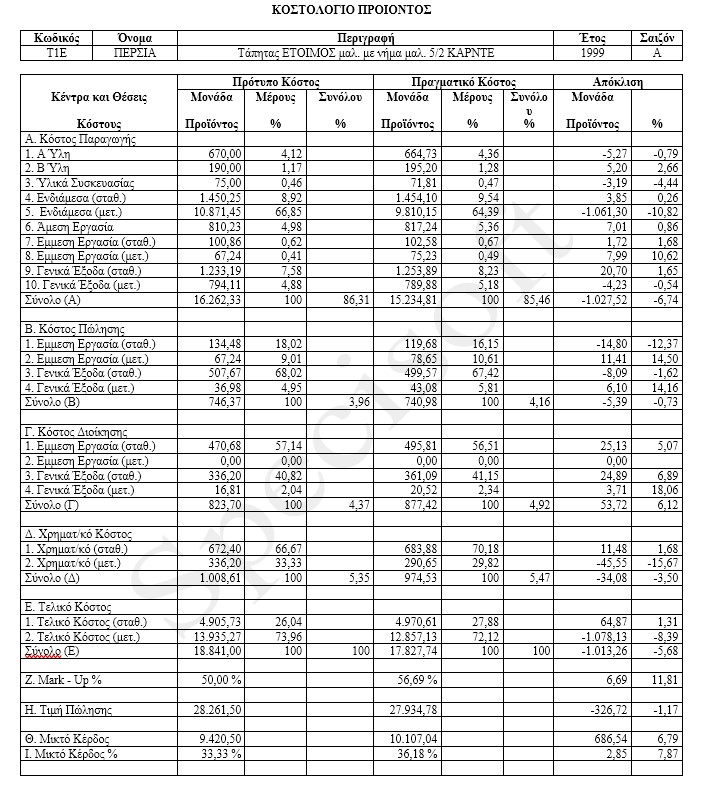
The purpose of costing a product is to determine its total cost and where it comes from, and then to compare it with the actual cost and find the cause of any variances
We therefore want to know its individual cost components, which are:
- The Production Cost, divided into cost of materials, direct labour, share of indirect labour and share of General Industrial expenses
- The Cost of Selling, divided into indirect labour and share of General expenses
- The Administration Cost, divided into indirect labour and share of General expenses
- The Financial cost
We thus have the actual total cost of the product, wherever it comes from.
Without this analysis it is impossible to know the actual cost of the product and, of course, to find the price at which we should invoice at a profit.
The next page shows the final cost statement of a product and the data used to calculate it
11. Investment appraisal & calculation of its return (IRR, NPV)
 The elements of an investment are:
- The Cost
- The Financing
- The determination of Sales
- The determination of expenses
The purpose of an investment is to make a profit as described in the appraisal study.
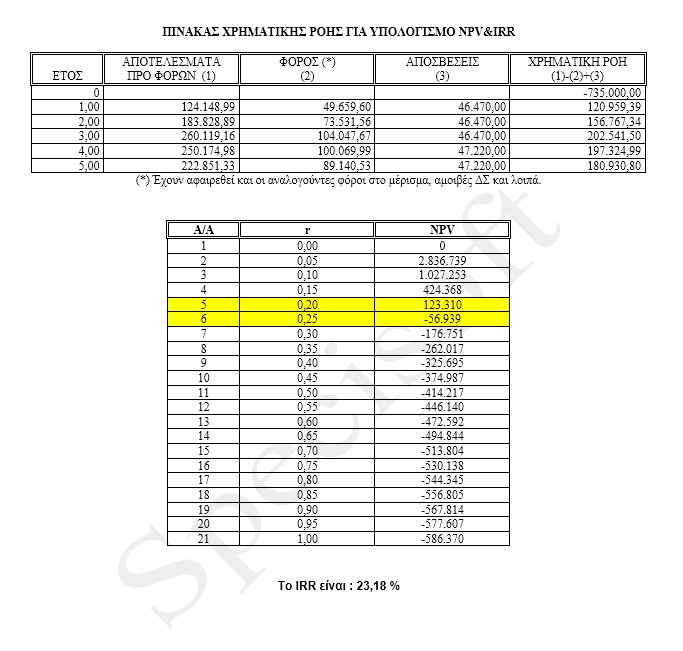
The usual appraisal criteria are IRR and NPV, that is, the internal rate of return and the net present value.
If a rate of return is achieved that the business considers good or (equivalently) if the net present value is positive for the return the business wants, the investment is approved and implemented.
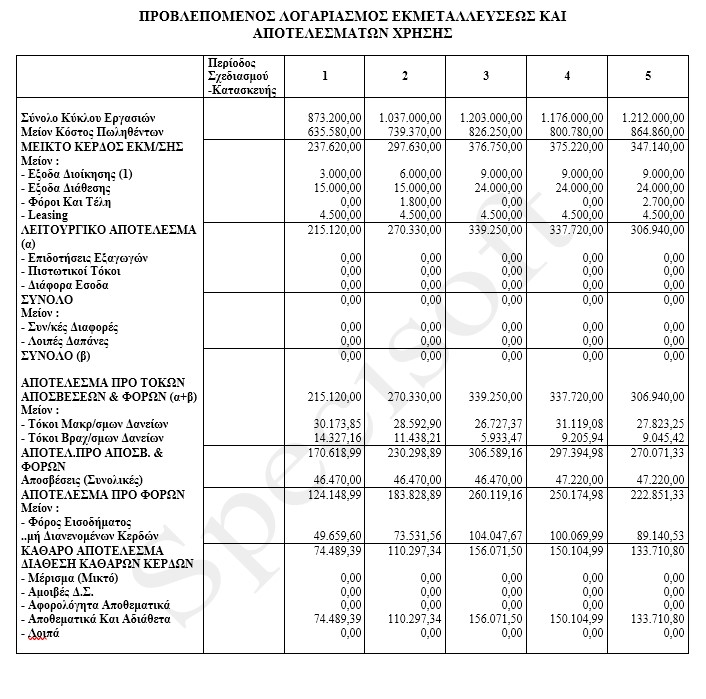
Methodologically, and with some abstraction, first the cost of the investment is estimated, then the financing is decided, the income per year for the following years is estimated, as are the expenses and depreciation per year, and the income statement table is drawn up for, usually, five years from the start of operation of the investment.
The income statement table is reached after calculating a host of figures and tables, such as working capital, production costs, cost of goods sold etc., as we know them.
The next page shows the calculation of these figures in a table.
12. Added value
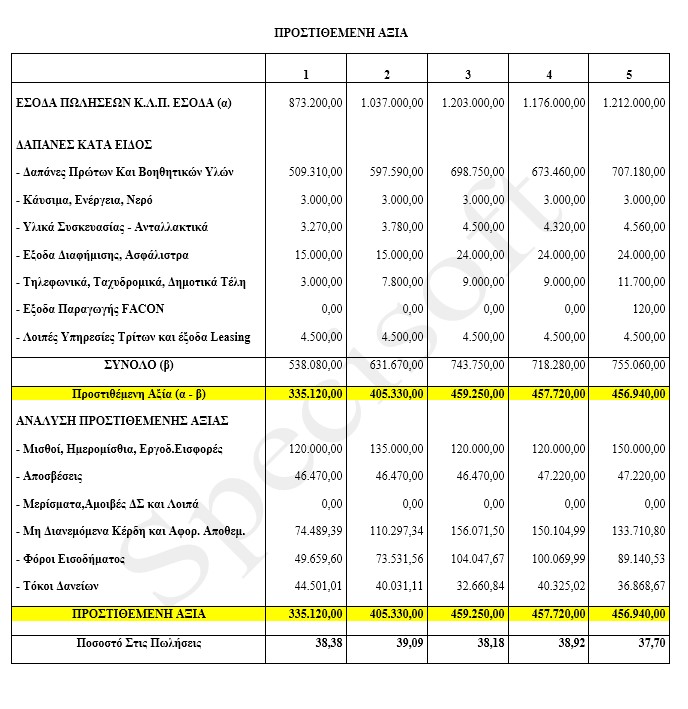
It is basic for a business to determine the added value it creates.
Added value is the value created within the boundaries of the business.
It is calculated by subtracting from total sales (outflows) the amount paid for the purchase of materials and third-party services (inflows).
It thus reveals what value is created by the operation of the business
A business is important if it creates large added value, something that is rated positively when applying for inclusion in development laws
The next page shows how added value is determined and its analysis
The Company Specisoft S.A.
Specisoft S.A. was founded in 1987 as a specialised software development company, its main characteristic being the development of software on subjects involving knowledge, high specialisation, special optimisation algorithms and very large-scale data processing.
The subjects of the programs (among others) concern a) Business software (Business Planning – Business Plan, Financial Analyses of Balance Sheets, Business Valuation, Standard Costing, Forecasts, Investment Appraisals etc.), b) Financial software (Fundamental Analysis, Portfolio Selection etc.), c) Business Games (Business Simulators), d) Optimisation of Economic Problems, e) Educational software on the above subjects.
The programs run on WINDOWS locally, on a network and over the INTERNET.
Almost all the company’s employees are university graduates. In addition, the company employs specialised, highly experienced external associates holding postgraduate degrees (Master’s and PhD) and has university professors as advisers.
The company’s customers are Businesses, Business Consultants, Accounting firms, Public Organisations, Municipalities etc. Among its customers (the company has more than one thousand seven hundred) are many of the largest Greek companies, more than eighty-five of them listed on the Athens Stock Exchange. A very important part of the company’s customer base is the Greek higher-education Institutions (universities and technological institutes), Vocational education (Public and Private vocational institutes), Colleges, Seminar Organisations, Vocational Training Centres etc., which equip their laboratories with the company’s programs, used directly in the training of their students.
Specisoft, with its software technology, its specialised optimisation algorithms and the knowledge of specialist financial subjects that it embodies in the software it produces, can be described as a knowledge company within the emerging knowledge economy.
Specisoft S.A.
17 Pergialitou St., 15451 Neo Psychiko
Tel: +30 210-6911468, Fax: +30 210-6993791
e-mail: info@specisoft.gr, SITE: www.specisoft.gr