

Contents
- The Liquidity of Businesses
- Types of Liquidity
- Problems in Determining Liquidity
- Changes in Liquidity
- The Current Ratio
- Explanations of the Ratios
- Ratios, Standard Ratios, Reliability of Ratios
THE LIQUIDITY OF BUSINESSES
Liquidity is the ability of the business to meet its payments.
The liquidity ratios refer to the level and relationships of the short-term liabilities that are about to fall due and to the current assets, which are supposed to be the source from which the liabilities will be met.
Determining liquidity is linked to the study of net working capital. Questions arise that must be answered.
- Will current debts be paid on time?
- Is Management using Working Capital effectively?
- Is the level of working capital satisfactory, excessive or non-existent?
- Does the business have a favourable credit rating from third parties?
- Is the current financial position of the business improving?
The current Financial position of the business is strong when it is able to:
- Meet the short-term claims of its creditors when they fall due.
- Maintain adequate Working Capital.
- Pay current Interest and Dividends.
- Maintain a favourable credit rating from third parties
TYPES OF LIQUIDITY
Liquidity is divided into Static and Dynamic
Static : shows the ability to pay at the moment the Balance Sheet is drawn up
It is used by EXTERNAL ANALYSTS
External determination of liquidity is possibly not realistic , because we do not know how readily the Assets can be liquidated.
Dynamic : It is used for the needs of the Business and is derived from internal Accounting data .
To obtain a true picture of liquidity, the assets must be classified by degree of liquidity and the liabilities by degree of maturity .
The Fixed assets should be matched by Permanent Capital (Equity and Long-term Liabilities).
The Current Assets or Working Capital should be matched by Short-term Liabilities.
PROBLEMS IN DETERMINING LIQUIDITY
- INVENTORIES
1.1 How were they valued? Valuation Methods and Practice
1.2 To what extent can they be liquidated? (old, obsolete)
1.3 How quickly are they liquidated? (turnover)
- RECEIVABLES
2.1 What part of them is secure?
2.2 How easily are they collected?
2.3 How real are they?
- CUSTOMER ADVANCES
To what extent are they a liability to be paid?
- ADVANCES TO SUPPLIERS
To what extent are they a receivable to be collected?
- DIVIDENDS PAYABLE
Since they are debts to Shareholders – Owners, to what extent are they considered short-term debts affecting liquidity?
CHANGES IN LIQUIDITY
Liquidity is an important factor of Stability and progress for every Business.
- Excessive Liquidity : harms Profitability
- Insufficient Liquidity: brings a cash shortage capable of leading to collapse.
- INCREASE IN LIQUIDITY
- Capital Increase by cash contribution
- Sale of Fixed Assets and inventories
- Long-term Borrowing
- DECREASE IN LIQUIDITY
- The opposite moves to those for an increase
CONSEQUENCES OF A CHANGE IN LIQUIDITY
- A Capital increase will probably be beneficial when it does not reduce the owners’ share.
- Selling fixed assets and inventories is beneficial when they are surplus.
- Long-term borrowing should be on favourable terms.
THE CURRENT RATIO
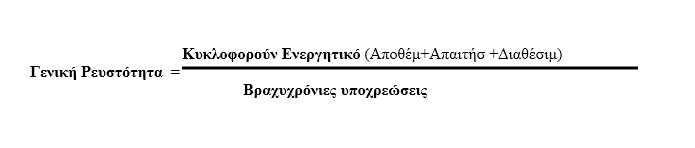
This ratio measures the surplus of liquid funds over current liabilities. It expresses a static view of which productive resources are available at a given moment to meet the liabilities of that moment.
< 1 : poor ratio. Insolvency problem for the business
From 1 – 2 : good ratio
From 2 – 3 : very good ratio
> 3 : funds are possibly lying idle instead of being used profitably
The Current Ratio must be related to:
(a) The Inventory Turnover Ratio
(b) The Average Receivables Collection Period
(c) The Average Period Short-term Liabilities Remain Outstanding
(b) < (c)
The Current Ratio must be accompanied by:
- An increase in the ratios
- Return on Equity
- Profit Retention Rate
- Rate of Change in Profits
- Degree of Fixed-Asset Intensity
- Rate of Change in Equity
> Previous year >= Sector average
- A decrease in the ratios
2.1 Debt-to-Equity Ratio
2.2 Debt Pressure Ratio
< Previous year <= Sector average
If two Businesses in the same sector have the same Current Ratio, the Business with a large proportion of its Current Assets in CASH has greater liquidity than one with a larger proportion in INVENTORIES
EXPLANATIONS OF THE RATIOS
- RETURN ON EQUITY
= (Profit for the year before tax / Equity)
It is, in other words, the interest rate on the annual lending of the Capital.
The higher it is, the better
- PROFIT RETENTION RATE
= (Reserves of the year / Net Profit for the year)
It shows the percentage of Profits kept in the business for self-financing.
The higher it is, the better
- RATE OF CHANGE IN GROSS PROFIT
= (Gross Profit of the current year / Gross Profit of the previous year)
It shows, as a percentage, the size of this year’s gross profit in relation to the previous year’s gross profit.
The higher it is, the better
It becomes even better when the ratio rises
Depreciation as a Percentage of Expenses
= (Depreciation for the year / Expenses for the year)
Comparing annual depreciation (if it is not included in cost) with total expenses shows, as a percentage, how much of the year’s expenses is depreciation of fixed assets.
- DEGREE OF FIXED-ASSET INTENSITY
= (Net book value at year end / Total Assets )
It shows, as a percentage, the part of total Capital invested in Fixed assets.
The higher it is, the better
- RATE OF CHANGE IN EQUITY
= (Equity of year E / Equity of year E-1 )
Equity at the end of the year is compared with that at the end of the previous year, to establish the degree of self-financing and growth of the business in terms of capital.
The higher it is, the better
- DEBT-TO-EQUITY RATIO
= (Debt / Equity )
Debt is compared with Equity at the end of the year to establish how far debt exceeds equity and to determine the degree of autonomy and independence of Management’s will.
The lower it is, the better
- DEBT PRESSURE RATIO
= (Debt / Total Capital )
It is used to determine the room for further external financing.
The lower it is, the better
RATIOS, STANDARD RATIOS, RELIABILITY OF RATIOS
When the figures of the BALANCE SHEET are related to one another, they give ratios that are useful tools of analysis and management.
The Ratios express in quantitative terms characteristic relationships between elements of the business and the events that make up its activity.
Studying the ratios in combination allows us to see the present situation, whether it is improving or not, what depends on what and to what degree
Their course over time must be monitored, to see how they change after certain decisions and so show us how effective those decisions were.
We must compare them with those of competitors and of the sector in which the business operates.
We also compare them with the budget ratios to see the consequences of the variances.
Calculating the value of a ratio becomes meaningful when it is compared with a STANDARD . Such standards can be:
- Ratios and percentages from the past showing the performance of the business.
- Ratios and percentages based on data of a selected group of competitors.
- Ratios and percentages based on the data of all the businesses in the sector.
- Ratios and percentages based on the data of the business’s budget.
The Standard ratios , in order to be considered reliable , must be formed for businesses of one sector that have the following characteristics:
- A uniform accounting system, uniform classification of accounts, similar depreciation methods.
- A uniform financial year
- The same asset valuation policy
The Company Specisoft S.A.
Specisoft S.A. was founded in 1987 as a specialised software development company, its main characteristic being the development of software on subjects involving knowledge, high specialisation, special optimisation algorithms and very large-scale data processing.
The subjects of the programs (among others) concern a) Business software (Business Planning – Business Plan, Financial Analyses of Balance Sheets, Business Valuation, Standard Costing, Forecasts, Investment Appraisals etc.), b) Financial software (Fundamental Analysis, Portfolio Selection etc.), c) Business Games (Business Simulators), d) Optimisation of Economic Problems, e) Educational software on the above subjects.
The programs run on WINDOWS locally, on a network and over the INTERNET.
Almost all the company’s employees are university graduates. In addition, the company employs specialised, highly experienced external associates holding postgraduate degrees (Master’s and PhD) and has university professors as advisers.
The company’s customers are Businesses, Business Consultants, Accounting firms, Public Organisations, Municipalities etc. Among its customers (the company has more than one thousand seven hundred) are many of the largest Greek companies, more than eighty-five of them listed on the Athens Stock Exchange.
A very important part of the company’s customer base is the Greek higher-education Institutions (universities and technological institutes), Vocational education (Public and Private vocational institutes), Colleges, Seminar Organisations, Vocational Training Centres etc., which equip their laboratories with the company’s programs, used directly in the training of their students.
Specisoft, with its software technology, its specialised optimisation algorithms and the knowledge of specialist financial subjects that it embodies in the software it produces, can be described as a knowledge company within the emerging knowledge economy.
Specisoft S.A.
17 Pergialitou St., 15451 Neo Psychiko
Tel: +30 210-6911468, Fax: +30 210-6993791
e-mail: info@specisoft.gr, SITE: www.specisoft.gr