

The Balance Sheet and the Accompanying Statements
A. Balance Sheet
The Balance Sheet is the main financial statement, depicting like a photograph the financial position of the Business at a given moment (usually 31/12 or 30/6 of each year).
It consists of two columns, the first called Assets and the second called Liabilities
Liabilities show the sources of the funds managed by the Business, and Assets show where they are invested.
Put another way, liabilities are what the Business owes and Assets are where it has placed that money.
By this logic, the Business owes:
- To the shareholders, the capital they paid in
- Also to the shareholders, the profits it did not distribute (reserves)
- To the Banks, the long-term Loans they granted it
- Also to the Banks, the short-term (working capital) Loans
- To Suppliers, for the Products and Services it bought
- To the State, the taxes it is obliged to pay etc.
By the Same logic, the Business has placed the above money in:
- Fixed Assets (buildings, machinery, software etc.)
- Investments in other Businesses
- Inventories (merchandise, materials, products)
- Receivables (e.g. from customers to whom it sold products on credit and from whom it claims the amount of the sale)
- Securities (shares, bonds etc.)
- Cash
It follows from the above that Assets and Liabilities are equal.
At this point it is useful to say what the Business is and, by induction, to arrive at the structure of the Balance Sheet accounts:
The Business in general
The Business, before the law, is a legal person, by analogy with the concept of the natural person.
It is born legally by a contract, is entered in books kept by the state, lives, acquires property, is governed by laws etc. and dies on a predetermined date, or if its founders so wish, or if it cannot meet its obligations.
From its establishment it also acquires its first money, that is, its initial capital, which however it owes at its end to those who provided it, that is, to its shareholders. To its shareholders it also owes the profits it makes each year, as well as whatever money from its profits it does not distribute, which is called reserves.
During its operation, it happens to borrow money from banks and others. It owes this money to those from whom it borrowed, within a predetermined period. If this period is long, lasting some years, it is called long-term borrowing; if it owes the money within a short period, it is called short-term borrowing.
It also owes money to those who grant it certain facilities, that is, to those it should have paid because it bought something and, although it should have paid them, it owes them. It is as if they lend it an amount equal to the value of the purchase, the business pays them off at the time of purchase and owes them the ‘loan’ they gave it. These are called suppliers.
Through this mechanism we see that the business collects money from its shareholders, from banks, from its suppliers and from others who for some reason give it money.
All this money that the business owes is called Liabilities.
The business places the money it has collected somewhere. It places it in cash, in things it bought to fulfil the purpose for which it was set up, called fixed assets, in merchandise it buys, in bonds, in investments in other businesses, in credit facilities to its customers from the sales it makes, by analogy with the mechanism of its suppliers towards it; in general, the money it collects it places ‘somewhere’, and that ‘somewhere’ owes it to the business.
All this money that the business has placed somewhere, and that is owed to it, is called Assets.
From these elements the Balance Sheet is put together, in the structure presented below, depicting the asset structure of the business.
So the balance sheet is a financial statement that presents the financial position of the business, since it presents what the business owns and what it owes.
The liabilities side shows the sources of the business’s funds and the assets side shows their uses, that is, the investments of the business.
Structure of Balance Sheet Accounts and Interpretation
Asset Accounts
Capital due (balance of capital owed by the shareholders)
Formation expenses (expenses amortised over several years, e.g. Formation expenses of the Business)
Fixed Assets
- Intangible assets (Trademarks, Software etc.)
- Tangible assets (Buildings, Machinery etc.)
- Investments and other long-term receivables
Depreciation
Current assets
- Inventories (Merchandise, Materials, Products etc.)
- Receivables (Customer Balances etc.)
- Securities
- Cash and cash equivalents
Prepayments and accrued income (items relating to other financial years)
Liability Accounts
Equity
- Capital (share capital etc.)
- Share premium
- Revaluation differences – Investment grants
- Reserves
- Result carried forward
- Amounts intended for capital increase
Provisions (funds set aside for estimates of known future liabilities, e.g. staff Compensation)
Liabilities
- Long-term (Long-term Loans)
- Short-term
- Banks (working capital)
- Suppliers
- Others
Accruals and deferred income
B. The Income Statement
The Income Statement shows what resulted from the operation of the Business during the year.
That is, it shows the financial result (profit or loss) the business had from its operation in the past year, that is, in the financial year.
The structure of the income statement, and how the financial result (profit or loss) is arrived at, is shown below
Income Statement Accounts
Net Results for the Year =
Turnover (sales)
– Cost of sales (= Gross Operating results)
+ Other operating income (= Total operating income)
– General and Administrative expenses
– General and Distribution expenses (= Partial operating results)
+ Income from investments, securities, interest received
– Expenses of investments, securities, interest paid (= Total operating results)
+ Extraordinary income
– Extraordinary expenses (= Ordinary and extraordinary results)
– Depreciation of fixed assets less that included in operating cost
The Financial side of the Balance Sheet
Without loss of generality, we can say that the Balance Sheet is:
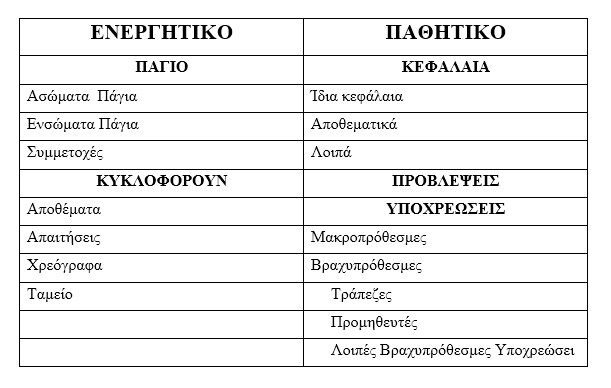
The above clearly shows the ranking of Asset and Liability items in order of liquidity. That is, the Assets that are hardest to liquidate are shown higher up in the statement.
Similarly, and by analogy, the items due in the longest term are higher up in the statement under Liabilities.
It is clear that a basic factor in the financial health of the business is the best possible matching of Long-term Assets, which are the basic Investments of the Business (Buildings, Machinery etc.), with Long-term Liabilities. It is a basic mistake, for example, to finance Fixed Assets from Short-term borrowing (e.g. from working capital loans), because fixed assets yield their benefits to the Business over time, while Short-term borrowing is repayable in the short term
The above is a comment on reading and using the data of the Balance Sheet.
Other elements are:
- What the development of the Balance Sheet items is and what it means
- What the sources and uses of the business’s funds are (how the Business is financed)
- What the Break-even point of the Business’s operation is and its sensitivity
- What the cash Flows from the Operating, Investing and Financing activities of the Business are
- What the basic Financial ratios are and what they reveal
These and many other elements are the subject of later articles
The pages that follow show a typical condensed Balance Sheet and Income Statement of a Business, as well as charts of the Development of Assets, Liabilities and Results.
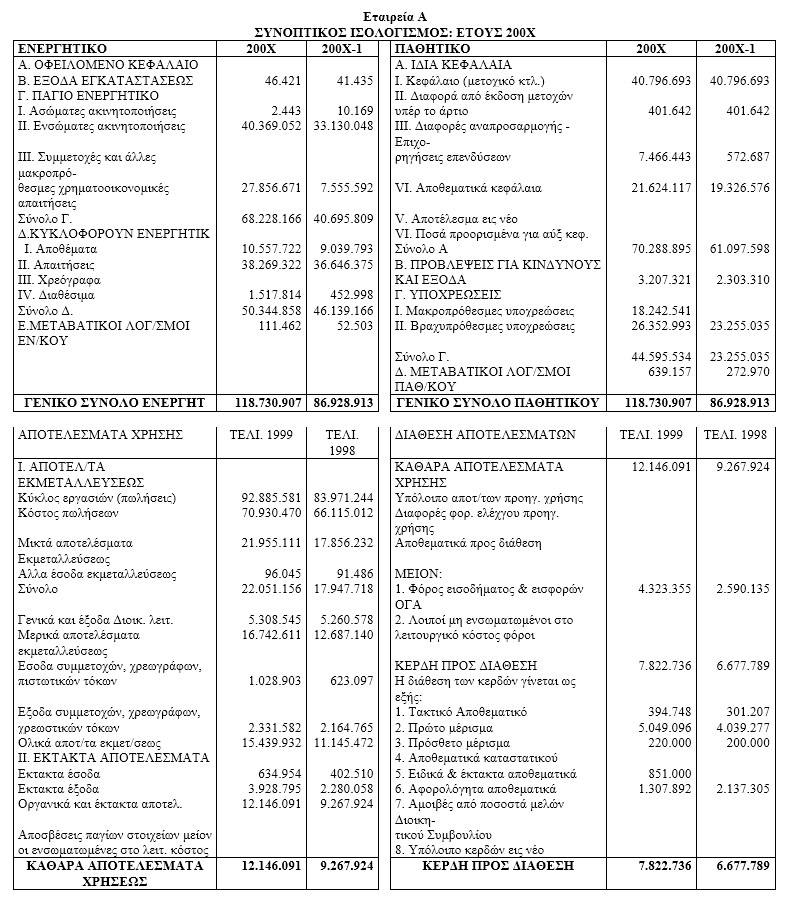
ASSETS
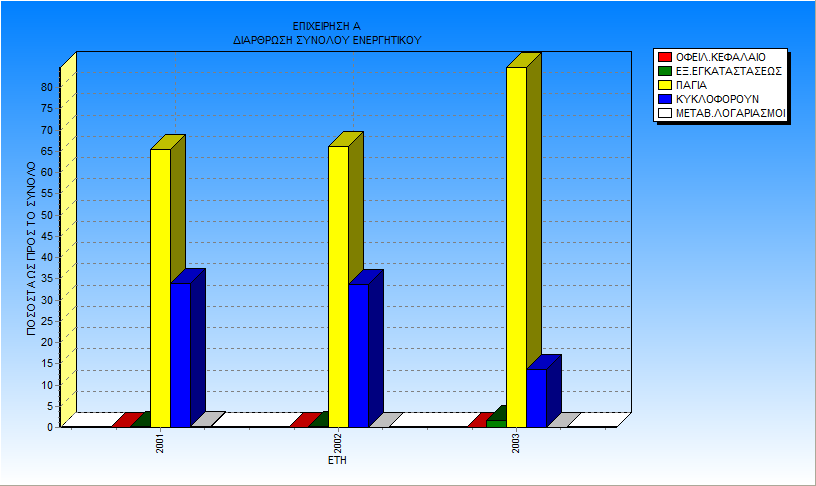
Development of Assets over Time
LIABILITIES
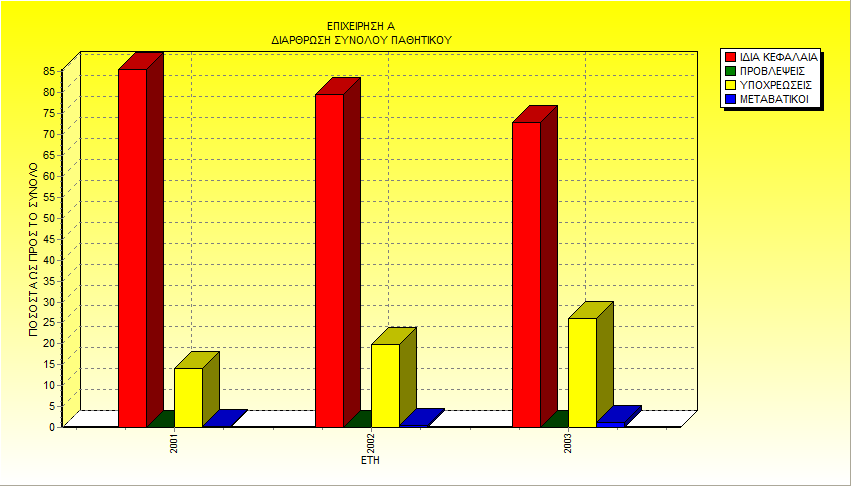
Development of Liabilities over Time
INCOME STATEMENT
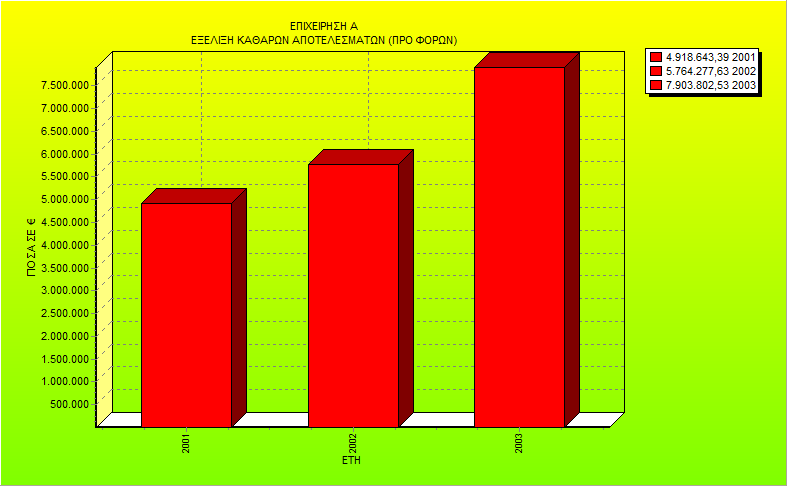
Development of the Income Statement over Time
The Company Specisoft S.A.
Specisoft S.A. was founded in 1987 as a specialised software development company, its main characteristic being the development of software on subjects involving knowledge, high specialisation, special optimisation algorithms and very large-scale data processing.
The subjects of the programs (among others) concern a) Business software (Business Planning – Business Plan, Financial Analyses of Balance Sheets, Business Valuation, Standard Costing, Forecasts, Investment Appraisals etc.), b) Financial software (Fundamental Analysis, Portfolio Selection etc.), c) Business Games (Business Simulators), d) Optimisation of Economic Problems, e) Educational software on the above subjects.
The programs run on WINDOWS locally, on a network and over the INTERNET.
Almost all the company’s employees are university graduates. In addition, the company employs specialised, highly experienced external associates holding postgraduate degrees (Master’s and PhD) and has university professors as advisers.
The company’s customers are Businesses, Business Consultants, Accounting firms, Public Organisations, Municipalities etc. Among its customers (the company has more than one thousand seven hundred) are many of the largest Greek companies, more than eighty-five of them listed on the Athens Stock Exchange.
A very important part of the company’s customer base is the Greek higher-education Institutions (universities and technological institutes), Vocational education (Public and Private vocational institutes), Colleges, Seminar Organisations, Vocational Training Centres etc., which equip their laboratories with the company’s programs, used directly in the training of their students.
Specisoft, with its software technology, its specialised optimisation algorithms and the knowledge of specialist financial subjects that it embodies in the software it produces, can be described as a knowledge company within the emerging knowledge economy.
Specisoft S.A.
17 Pergialitou St., 15451 Neo Psychiko
Tel: +30 210-6911468, Fax: +30 210-6993791
e-mail: info@specisoft.gr, SITE: www.specisoft.gr